Optimal Interfacial Band Bending Achieved by Fine Energy Level Tuning in Mixed-Halide Perovskite Solar Cells
Rattachement africain : gb, sa. Niveau de preuve : code pays fourni par la source.
Le résumé fourni par la source
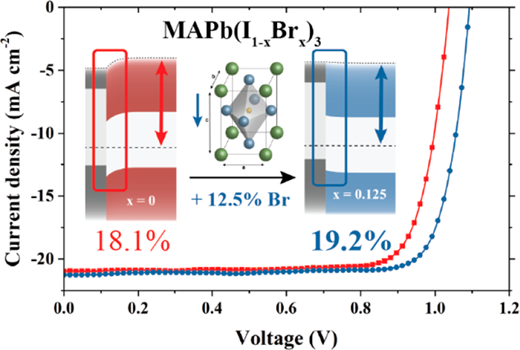
Most highly efficient perovskite solar cells employ mixed iodide–bromide photoactive layers; however, understanding the beneficial effect of the low (5–15 mol %) bromide content is incomplete. Here, a series of MAPb(I 1– x Br x ) 3 perovskite layers are investigated to understand the origin of the high peak power conversion efficiency (19.2%) observed at small bromide content (0.10 ≤ x ≤ 0.125). For the x = 0.125 perovskite, 200 meV shallower energy levels are revealed, accompanied by a reduced density of trap states and stable tetragonal mixed-halide phase with compressed unit cell. In contrast, the higher bromide content samples ( x > 0.125) show deeper energy levels, cubic perovskite crystal structure, and signs of halide segregation. Surface photovoltage measurements unveil an undesirable band bending at the hole transport layer/perovskite interface for MAPbI 3 and x > 0.125 mixed-halide layers, which is eliminated for the x = 0.125 perovskite because of its shallower Fermi level, enabling enhanced device performance.
Ce résumé expose les affirmations des auteurs. BNTIC ne l’interprète pas comme une validation indépendante des résultats.
Le contrôle bibliographique ouvert
DOI retrouvé dans Crossref DOI retrouvé ; titre concordant.
- Titre Crossref
- Optimal Interfacial Band Bending Achieved by Fine Energy Level Tuning in Mixed-Halide Perovskite Solar Cells
- Date Crossref
- 21/10/2021
- Éditeur
- American Chemical Society (ACS)
- Type
- journal-article
Ce recoupement confirme des métadonnées liées au DOI. Il ne confirme ni la méthode ni les conclusions de l’étude, et il ne compte pas comme une seconde source scientifique indépendante.
Les institutions déclarées
Une affiliation ne permet pas de déduire la nationalité d’un auteur.