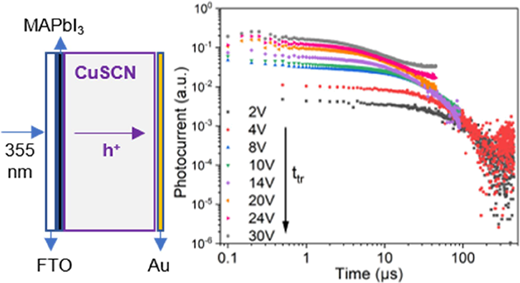
Determining Out-of-Plane Hole Mobility in CuSCN via the Time-of-Flight Technique To Elucidate Its Function in Perovskite Solar Cells
Rattachement africain : gb, sa. Niveau de preuve : code pays fourni par la source.
Le résumé fourni par la source
Copper(I) thiocyanate (CuSCN) is a stable, low-cost, solution-processable p-type inorganic semiconductor used in numerous optoelectronic applications. Here, for the first time, we employ the time-of-flight (ToF) technique to measure the out-of-plane hole mobility of CuSCN films, enabled by the deposition of 4 μm-thick films using aerosol-assisted chemical vapor deposition (AACVD). A hole mobility of ∼10 –3 cm 2 /V s was measured with a weak electric field dependence of 0.005 cm/V 1/2 . Additionally, by measuring several 1.5 μm CuSCN films, we show that the mobility is independent of thickness. To further validate the suitability of our AACVD-prepared 1.5 μm-thick CuSCN film in device applications, we demonstrate its incorporation as a hole transport layer (HTL) in methylammonium lead iodide (MAPbI 3 ) perovskite solar cells (PSCs). Our AACVD films result in devices with measured power conversion efficiencies of 10.4%, which compares favorably with devices prepared using spin-coated CuSCN HTLs (12.6%), despite the AACVD HTLs being an order of magnitude thicker than their spin-coated analogues. Improved reproducibility and decreased hysteresis were observed, owing to a combination of excellent film quality, high charge-carrier mobility, and favorable interface energetics. In addition to providing a fundamental insight into charge-carrier mobility in CuSCN, our work highlights the AACVD methodology as a scalable, versatile tool suitable for film deposition for use in optoelectronic devices.
Ce résumé expose les affirmations des auteurs. BNTIC ne l’interprète pas comme une validation indépendante des résultats.
Le contrôle bibliographique ouvert
DOI retrouvé dans Crossref DOI retrouvé ; titre concordant.
- Titre Crossref
- Determining Out-of-Plane Hole Mobility in CuSCN via the Time-of-Flight Technique To Elucidate Its Function in Perovskite Solar Cells
- Date Crossref
- 07/08/2021
- Éditeur
- American Chemical Society (ACS)
- Type
- journal-article
Ce recoupement confirme des métadonnées liées au DOI. Il ne confirme ni la méthode ni les conclusions de l’étude, et il ne compte pas comme une seconde source scientifique indépendante.
Où se fait cette recherche
-
Queen Mary University of London pays non établi dans la noticeUniversité ou école supérieure
-
Imperial College London Department of Materials and Centre for Processable Electronics pays non établi dans la noticeUniversité ou école supérieure
-
King Abdullah University of Science and Technology Division of Physical Sciences and Engineering pays non établi dans la noticeUniversité ou école supérieure
-
School of Engineering and Materials Science and Materials Research Institute pays non établi dans la noticeUniversité ou école supérieure
-
School of Physics and Astronomy pays non établi dans la noticeUniversité ou école supérieure
Queen Mary University of London, Department of Materials and Centre for Processable Electronics — Imperial College London et Division of Physical Sciences and Engineering — King Abdullah University of Science and Technology, avec 2 autres affiliations.
Une affiliation ne permet pas de déduire la nationalité d’un auteur.